Organizing a home library and lending books without losing them
Most home libraries are organized in the head of one person, and that works until a friend borrows a book and nobody remembers who. Books that are lent out and never come back are the most common loss in a home library. This guide shows how to catalog your books, keep track of loans, and follow a series or a reading goal, using a simple spreadsheet and a few printed slips.
Start with a catalog
A catalog is a list with one book per row. The columns that earn their place are:
- Title and author.
- Series name, and the book's number in the series.
- Format: hardcover, paperback, ebook.
- Shelf or room, so you can find it.
- Whether you own it.
- Reading status: unread, reading, finished.
- Pages, and the date you finished it.
Do not try to catalog everything in one sitting. Start with one shelf. Ten minutes a day over a week or two will cover most households. Add new books when they come in the door, and the catalog stays current.
Lend with a routine, not a memory
The routine that works has four steps, and each takes under a minute:
1. When a friend borrows a book, fill in a small lending slip with their name and the return date, and tuck it inside the cover. 2. Log the loan in the spreadsheet: the book, whether it is lent out or borrowed, the person, today's date and the due date. 3. When the book comes back, enter the date returned. 4. Look at your overdue list every week or two.
The slip inside the cover is the safety net. If the spreadsheet is lost or you forget to check it, the book itself says who has it.
Let the spreadsheet flag the status
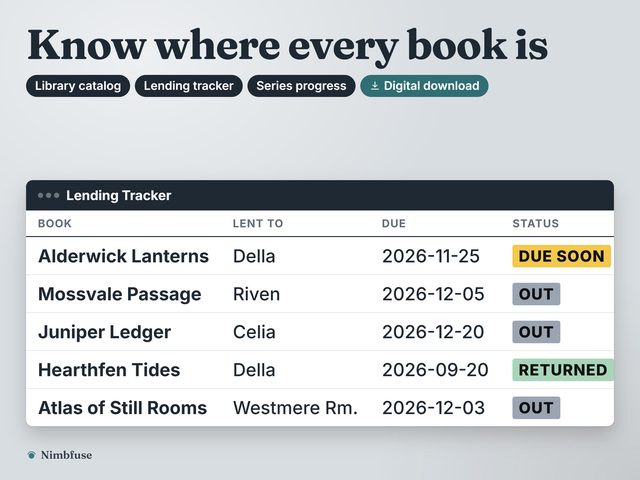
A good lending sheet does the counting for you. A book is overdue if it has not been returned and the due date has passed. It is due soon if the due date is within the next seven days. It is out if it is lent out with more than seven days to go, and returned once a return date is recorded. A single "where is it" column on your catalog can then show whether each book is on the shelf, lent to a named person or borrowed from a named person or library.
Borrowed books deserve the same care as lent ones. A library book with a due date is easier to return on time when it appears on the same list as your own loans.
Follow your series
Series are where a catalog earns its keep. If you read multi-volume series, list the series name and the number of books in it. Counting the books you have read gives you a progress figure and tells you which volume to read next. A progress bar that fills as you finish volumes is a small thing that many readers enjoy.
Set a reading goal
A yearly goal does not need to be ambitious. Set a number of books, and log the month each one is finished, with its pages. At a glance you can see how many books you have finished, how many pages, and what percent of your goal you have reached. A goal that you can see is easier to keep.
Keep a wishlist
A wishlist is a short list of books you want to read or buy next, with an author, a priority and a note. Notes such as "recommended by a friend" or "book club pick" help you remember why a title is there. When you are in a bookshop or a library, you do not have to rely on memory.
Mark your books
A bookplate with your name on the inside cover makes a book easy to identify when it has been borrowed. It also makes a nice touch for a book you give away. Print them on ordinary paper or cardstock, cut them out and paste them in.
Keep it manual
A home library does not need an app that syncs with a reading site, a barcode scanner or macros. A spreadsheet you type into is enough, and it keeps working without an internet connection. Keep a clean backup of the blank file before you enter your collection.
A tracker that does this
Nimbfuse has a Home Library Spreadsheet: a book tracker and lending tracker for Microsoft Excel and LibreOffice. It catalogs up to 300 books, tracks up to 150 loans with RETURNED, OVERDUE, DUE SOON and OUT flags, follows up to 40 series with progress bars and the next volume to read, keeps a monthly reading log against a yearly goal, and holds a wishlist of up to 100 titles. A dashboard shows books lent out and borrowed, overdue and due soon. The download includes a sample workbook with 12 fictional rows, a blank workbook, a guide, and a printable page of 8 lending slips and 8 bookplates. It is manual entry, with no app sync and no barcode scanning. It is a digital download on our Etsy shop, and the product page is on this site.